Plan Your Project
Bring this design into your kitchen.
Free 30-minute design consultation at our Boynton Beach showroom. See the slabs, talk through your kitchen, and get a real timeline + ballpark.
★★★★★ 5.0 · 586+ Google reviews · Family-owned since 2008
Understanding Vein Patterns and Movement
Bold veining in natural stone follows geological patterns created over millions of years through mineral deposits, pressure, and heat. The most dramatic veining appears in metamorphic stones like marble and quartzite, where the transformation process creates flowing, river-like patterns. In our 500+ slab inventory at Boynton Beach, we categorize veining into several types: linear veining (parallel lines running in one direction), crosshatched (intersecting vein patterns), cloud or watercolor veining (soft, diffused patterns), and dramatic contrast veining (bold dark lines on light backgrounds or vice versa). Calacatta marble exemplifies dramatic contrast veining: thick gold and gray veins against bright white backgrounds. Quartzites like Taj Mahal, Fantasy Brown, and Cristallo offer similar drama with superior durability. When selecting slabs for maximum impact, look for consistent but varied vein movement; you want pattern interest across the entire kitchen, not just in one concentrated area. We photograph full slabs from multiple angles and in different lighting to help clients understand how veining will appear in their actual space.
Slab Orientation: Vein Flow Direction Matters
One of the most overlooked aspects of bold veining is slab orientation, the direction vein patterns flow across your countertops. In our fabrication process, we create full-scale layouts showing proposed vein direction before cutting, because this decision dramatically impacts the final aesthetic. For perimeter counters, most designers prefer veining that flows parallel to the front edge, creating horizontal movement that guides the eye along the counter length. This orientation is particularly effective in galley kitchens common in Boca Raton condos, where the linear flow emphasizes the space's geometry. Island countertops offer more creative flexibility; vertical vein orientation (perpendicular to the long edge) creates dynamic visual interest and makes the island a clear focal point. Book-matching, where two slabs are mirrored to create symmetrical patterns, works best with primarily vertical veining, as the mirror effect creates a butterfly or kaleidoscope appearance. For L-shaped and U-shaped kitchen layouts throughout Palm Beach County, we typically orient veining to flow naturally around corners, maintaining visual continuity rather than abrupt directional changes that can fragment the design.
See the Slabs
Want to see what this looks like in your kitchen?
500+ slabs in our Boynton Beach showroom. Browse the live inventory or book a private viewing.
Book-Matching and Pattern Continuity
Book-matching is the technique of cutting consecutive slabs from the same block and opening them like a book, creating mirror-image veining patterns. This approach amplifies the drama of bold veining, transforming random geological patterns into intentional, symmetrical design statements. The technique is most effective on large, uninterrupted surfaces. Kitchen islands are ideal candidates. We've created stunning book-matched islands in Wellington and Palm Beach Gardens using Calacatta Gold quartzite and Blue Bahia granite, where the symmetrical veining becomes the kitchen's defining feature. However, book-matching requires purchasing multiple slabs from the same bundle to ensure color and pattern consistency, which increases material costs by 20-35%. For perimeter counters with multiple seams, we recommend pattern continuity rather than book-matching, arranging slabs so veining flows naturally from section to section without forced symmetry. This requires careful planning during slab selection and layout design. In some cases, we create hybrid approaches: book-matching on the island for maximum drama, with natural pattern flow on perimeter counters for cohesive but not repetitive aesthetics.
Supporting Cast: Keeping Other Elements Simple
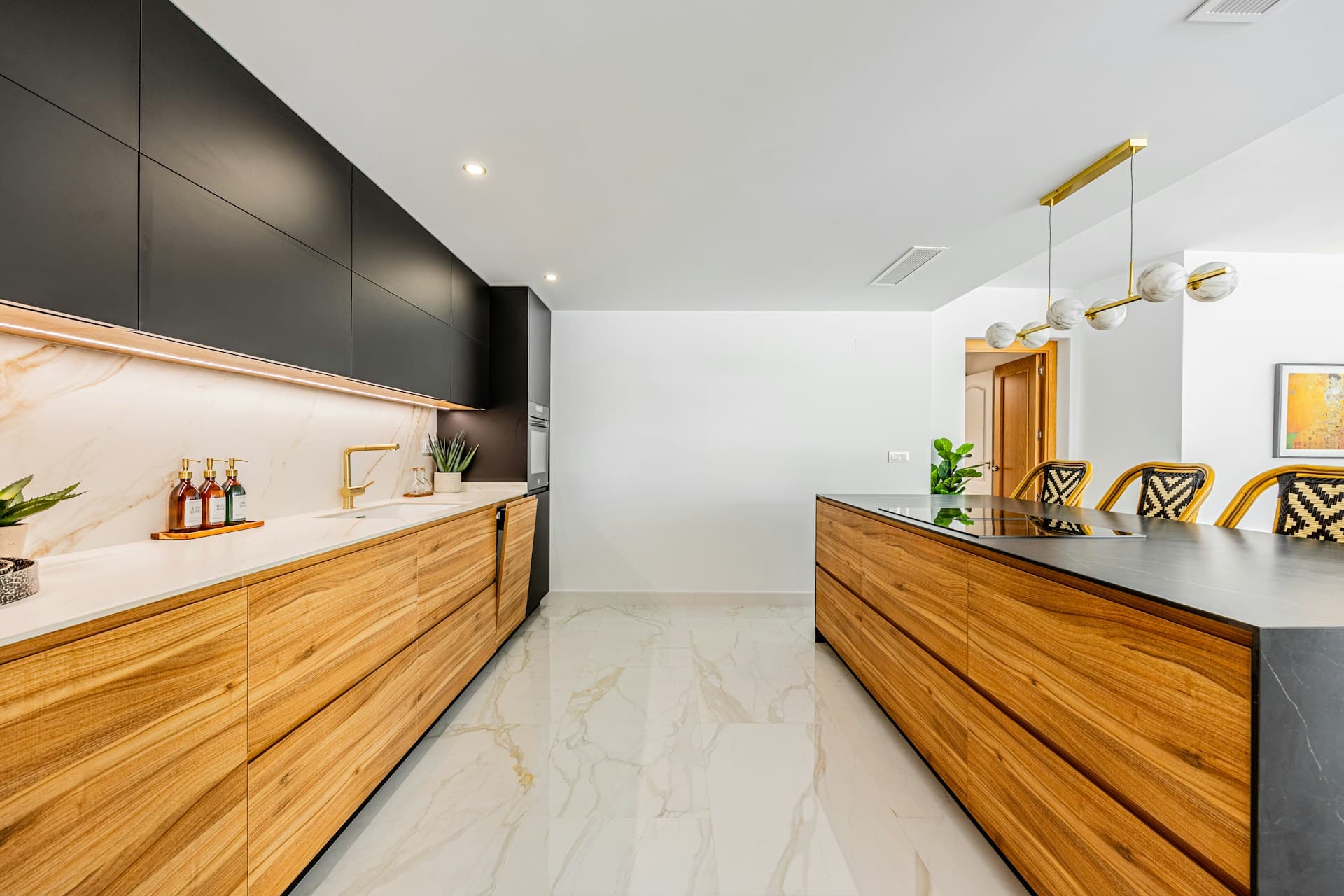
When your countertop features bold, dramatic veining, the rest of the kitchen design must play a supporting role. The principle is straightforward: one hero element, multiple supporting elements. Cabinetry should be simple and recessive. Flat-panel doors in solid colors work best. In South Florida luxury kitchens, we see successful combinations like bold Calacatta quartzite with matte navy or charcoal cabinetry, or Fusion quartzite with warm walnut flat-panel doors. Avoid competing patterns; if your counters feature dramatic veining, your backsplash should be subtle. Options include small-format solid tile, large-format porcelain in coordinating solid colors, or even painted drywall with a clear glass panel for protection. Hardware and fixtures should be simple and refined: brushed brass or matte black in clean, geometric shapes that don't compete with the stone's organic patterns. Lighting plays a crucial role in showcasing veining; we recommend under-cabinet LED strips with high color rendering (CRI 90+) to accurately display the stone's colors and shadows created by vein depth. For island pendants, choose simple globe or cylinder shapes in transparent or translucent materials rather than ornate fixtures that would create visual competition.
Scale Considerations for Different Kitchen Sizes
Bold veining works differently depending on kitchen size and configuration. In compact kitchens common in Delray Beach and Lake Worth Beach older homes (120-150 square feet), dramatic veining can overwhelm the space if not carefully managed. For smaller kitchens, we recommend limiting bold veining to a single focal area, typically the island or a feature wall, while using more subtle materials on perimeter counters. Conversely, large open-concept kitchens in newer Wellington or Boca Raton homes (300+ square feet) can accommodate bold veining throughout without visual overwhelm; the expansive space provides enough visual breathing room for dramatic patterns. Counter depth also affects perceived impact; standard 25-inch deep counters show less vein pattern than extended 36-inch islands, so material selection should account for the actual square footage that will be visible. Waterfall edge installations amplify the drama by extending veining to vertical surfaces, effectively tripling the visible pattern area. In our experience, kitchens with 8-9 foot ceilings benefit from horizontally-oriented veining that emphasizes width, while kitchens with 10+ foot ceilings can accommodate more vertical drama without making the space feel bottom-heavy.
Lighting Strategies to Maximize Vein Drama
Proper lighting is essential for showcasing bold veining; without it, even the most dramatic stone can appear flat and lifeless. We recommend a three-layer lighting approach for countertop drama. First, task lighting through under-cabinet LED strips provides direct illumination that highlights vein depth and creates subtle shadows. Install these 2-3 inches from the front cabinet edge for optimal grazing effect. Second, ambient lighting from recessed ceiling fixtures should include dimmers for flexibility; too-bright overhead lighting can wash out vein contrast, while properly dimmed illumination enhances depth perception. Third, accent lighting, particularly for islands, creates focal drama. We've installed perimeter toe-kick lighting beneath islands with book-matched quartzite, where the upward glow creates an ethereal floating effect while emphasizing the vertical waterfall veining. Natural light presents both opportunities and challenges; south-facing kitchens in Palm Beach County receive intense sun that can bleach out subtle vein colors in certain stones. For these orientations, we recommend materials with high contrast veining (dark on light or light on dark) rather than subtle tonal variations that might disappear in bright conditions.
See Dramatic Veining Options in Person
Photographs and samples cannot convey the true impact of dramatic stone veining. You need to see full slabs to understand scale and pattern flow. Our Boynton Beach showroom displays complete slabs of Calacatta and Carrara marble, Taj Mahal and Fantasy Brown quartzite, and numerous exotic granites with bold movement. We can create digital renderings showing your selected slab with proposed vein orientation in your actual kitchen layout, eliminating guesswork about how the material will perform in your space. Our design team has extensive experience helping clients balance dramatic stone selections with supporting design elements for cohesive, sophisticated results. Ready to make your countertop the star of your kitchen? Schedule a private viewing at countertopspalmbeach.com/book-viewing or explore our inventory online. Use our design questionnaire at countertopspalmbeach.com/estimator to share your aesthetic preferences, and we'll pre-select slabs that match your vision for your showroom visit.